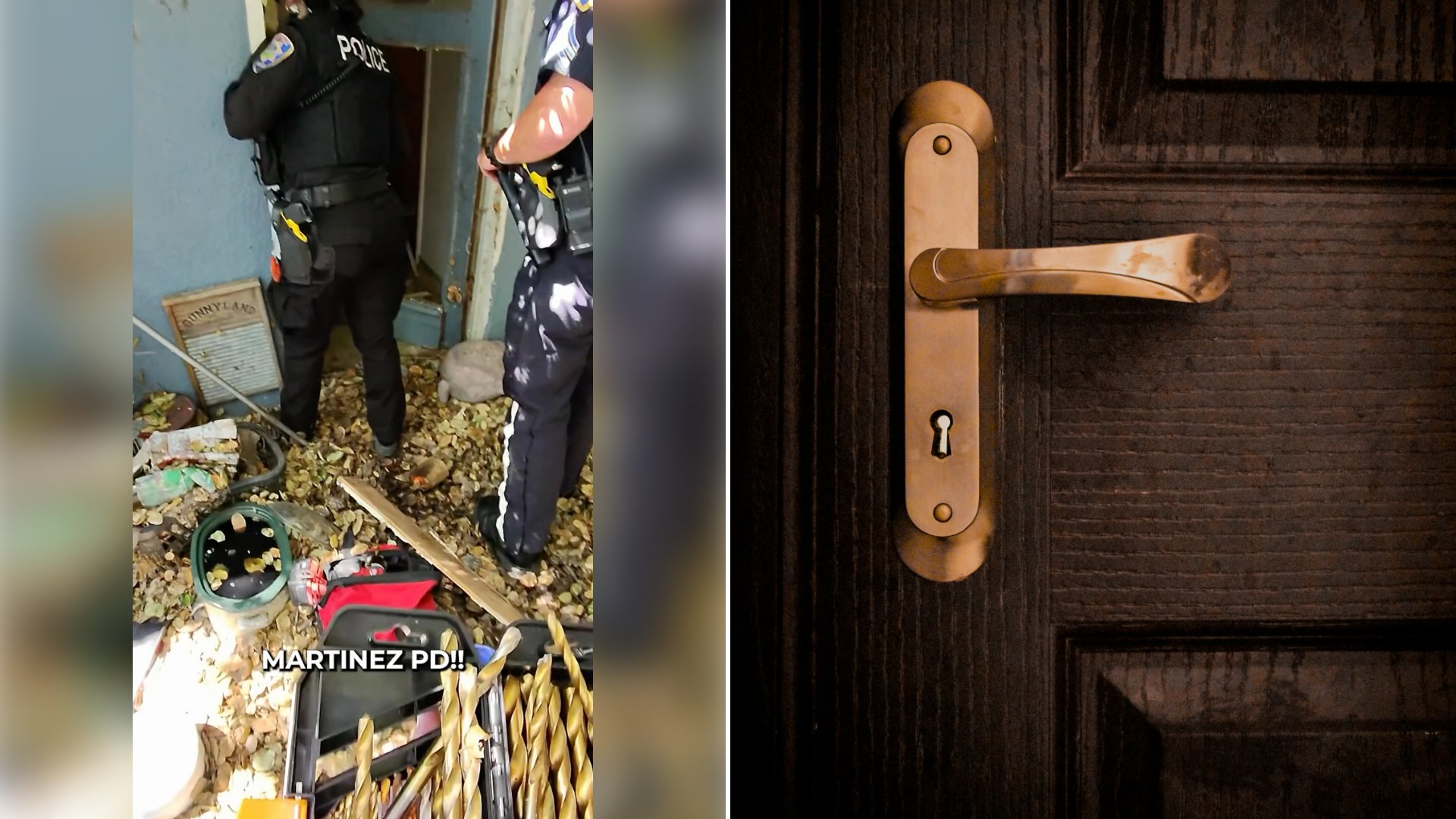
The deadbolt would not give, so the buyers moved to the back door. In a 56 second reel from @dawsoncriddle, the opening narration runs through the attempts in order: they tried to get into the house, could not get past the deadbolt, then went around to the back. A close-up shows a deadbolt with a drill beside it, and the next shot is from inside a cluttered room where uniformed officers stand among scattered debris, with on-screen text naming the local police department.
The caption tells the rest of the setup: “We had no clue she was living there. We showed up with the cops to change the locks.” It adds, “Apparently she had lived there for 12 years,” and “We bought this house sight unseen.” A text label at the top of the first scene asks the question the video leaves open: “Squatter or not?”
Most of the reel is a phone call. According to the narration, the police gave the buyers the woman’s number, and the next scene shows a man in a parked truck dialing it. The captions show him asking whether she is in her house. Her side, as the captions render it, is “I’ve lived here for 12 years” and “I’m out of town.” The captions also mention cats inside the house.
Both sides in the call land on the same complaint, and the captions carry it. One line reads “Nobody told me,” followed by “house sold.” Later comes “Nobody told us,” followed by “in the house.” The man says “Oh wow okay!” and “That’s crazy,” and the call ends with a plan to be in touch later, with the captions reading “by dinner time” and “Let’s be in touch tonight.” The caption on the post says “Follow for Part 2!!”, so how it was resolved is not in this video.
The comments on the reel add some practical questions. One viewer asked how the woman knew they were trying to drill the lock, and the creator replied that one of the neighbors called her. One commenter wrote that a purchase made sight unseen is at the buyer’s own risk.
The walkthrough point has an official basis. The Consumer Financial Protection Bureau tells buyers to do a final walk-through before signing any papers, to confirm the seller has made the agreed repairs and that items the seller agreed to leave are still there, and to contact the seller right away if something is not done or missing. The bureau’s page does not set a time window for it. If you cannot attend in person, ask whoever is acting for you to do it and to send time stamped photos or video of every room, including the garage and any outbuildings, before funds move.
Ask for the occupancy status in writing before closing. The commenter who asked “So the listing didn’t disclose this status?” put a question to the seller side that a buyer can put in the contract stage: is the home vacant, and if not, who lives there and under what terms? Neither the caption nor the footage says what the sellers or the listing disclosed, so treat that question as the one to get answered, not as a finding.
Think about what happens if someone is inside after closing. The reel shows the buyers arriving with officers to change the locks, and the woman on the call saying she has lived in the home for 12 years. The reel’s on-screen text points to a California police department, and in California, according to the state judicial branch’s self help eviction page, a landlord cannot lock a tenant out, shut off utilities or throw out belongings. The page says an eviction goes through the court: written notice with a deadline, then an unlawful detainer case, then a writ of possession that directs the sheriff to evict. That page addresses landlords and tenants and does not mention new owners or other kinds of occupants, so a buyer who finds someone inside should not assume a lock change is the right first move. Get a local real estate attorney on the phone before touching the doors, and keep every message with the occupant, the listing agent and the seller in one folder.
Keep a record of what you saw on day one. In this reel, the footage itself is the record: the deadbolt, the officers, the room full of debris. Photograph the condition of each room, note the date and time you arrived and who was present, and write down any statement the occupant makes about how long she has been there or what she was told about the sale. Those details are the ones a title company, an agent or an attorney will ask for first.
More from Willow and Hearth
- Real Estate Investor Confronts Squatters Inside the House He’s Flipping
- Couple Buys a House, Then Discovers a Squatter Inside Who Keeps Breaking Back In After Every Confrontation, and They Filmed the Standoff at the Front Door
- Sellers Are Increasingly Refusing to Move Out After Closing and Evicting Someone From a House You Now Legally Own Can Drag on for Months
Leave a Reply