Milwaukee rates its M18 FUEL hammer drill at 1,400 in-lbs of max torque. Makita rates a comparable 18V model at 530 in-lbs. DeWalt doesn’t publish a torque number for its 20V MAX XR drills at all anymore. It uses a completely different metric called UWO. None of that means Milwaukee’s drill hits nearly three times as hard as Makita’s, and it doesn’t mean DeWalt stopped competing on power. It means three manufacturers are measuring three different things and calling the result a spec sheet. If you’ve ever compared drills side by side and come away more confused than informed, that’s not a you problem.
Torque: real, but not standardized
Torque measures rotational force, usually in inch-pounds. It’s a genuinely useful number: it tells you how much resistance the drill can overcome before stalling, which matters for driving long lag bolts or drilling into hardwood. Milwaukee’s M18 FUEL 1/2″ Hammer Drill/Driver lists 1,400 in-lbs max torque at up to 2,100 RPM. Makita’s XPH12Z 18V LXT hammer drill lists 530 in-lbs at up to 2,000 RPM. The problem isn’t the measurement itself. It’s that “max torque” isn’t tested the same way by every brand, and a number on a box doesn’t tell you whether it was measured under conditions you’ll ever actually drill in.
When the advertised number and the real number don’t match
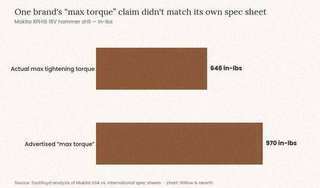
A tool-industry investigation from ToolGuyd found a gap worth knowing about: Makita’s newer 18V XPH16 hammer drill is marketed in the U.S. at “970 in-lbs max torque,” but the same tool’s international spec sheets show a real-world maximum fastening torque closer to 646 in-lbs, a 51% difference between the advertised figure and what the drill can actually deliver into a fastener. That’s not necessarily dishonest so much as it reflects two different testing standards being applied to the same hardware, but it means the number on the U.S. packaging isn’t apples-to-apples with a competitor’s number measured a different way. When ToolGuyd checked Makita’s XGT line by contrast, the advertised and actual torque figures matched within 1%. Same brand, wildly different gap, depending on the product line.
UWO: DeWalt’s answer, and why it’s not automatically better
DeWalt made the most direct break from torque marketing. Per DeWalt’s own support documentation, the company “no longer use[s] torque to rate the power of our drills but instead use Unit Watts Out or UWO,” which factors in the whole drivetrain (motor, transmission, clutch, and chuck) at the point where speed and torque output are both highest, rather than measuring torque in isolation. DeWalt’s logic is that UWO better reflects real jobsite performance than a torque number measured at stall. That’s a defensible argument, but it also means you cannot put a DeWalt UWO figure next to a Milwaukee or Makita in-lbs figure and learn anything. They’re not the same unit, and no public conversion factor lets you translate one into the other reliably.
The spec that actually locks you in
Voltage platform (DeWalt’s 20V MAX, Milwaukee’s M18, Makita’s 18V LXT, Ryobi’s ONE+ 18V) matters more than any torque or UWO number, because it determines every battery and charger you’ll buy for years. Chuck size (almost universally 1/2″ on drill/drivers now) and brushless-versus-brushed motor construction matter too: brushless motors run cooler, last longer, and squeeze more runtime per charge out of the same battery, which is a real, measurable difference rather than a marketing framing. RPM range is worth checking against your actual use case: a two-speed drill topping out around 2,000 RPM handles most household drilling and driving, and a higher ceiling mostly helps with small-diameter bits in soft material.
None of this means torque and UWO numbers are meaningless. They’re just not comparable across brands the way a price tag or a battery amp-hour rating is. The number that should actually drive a buying decision is which battery platform you’re already invested in, or willing to commit to, since that’s the spec you’re stuck with long after the torque rating on the box has stopped mattering.
How to actually compare two drills at the store
The reliable move is to ignore cross-brand torque and UWO comparisons entirely and instead compare within one manufacturer’s own lineup, where the measurement method is at least consistent. A brand’s compact drill versus its mid-tier versus its top-of-line hammer drill, measured the same way, tells you something real about where a given model sits in that company’s own range. From there, match the tier to the job: a compact 12V-class driver is genuinely enough for furniture assembly, curtain rods, and most interior trim work, while framing, deck-building, and driving into masonry call for the higher tier regardless of what the in-lbs or UWO figure claims on the box. Battery amp-hour rating (measured in Ah, printed clearly on every pack) is worth more attention than either torque figure — it’s standardized, directly comparable, and determines how long the tool actually runs before you’re back at the charger.
Leave a Reply