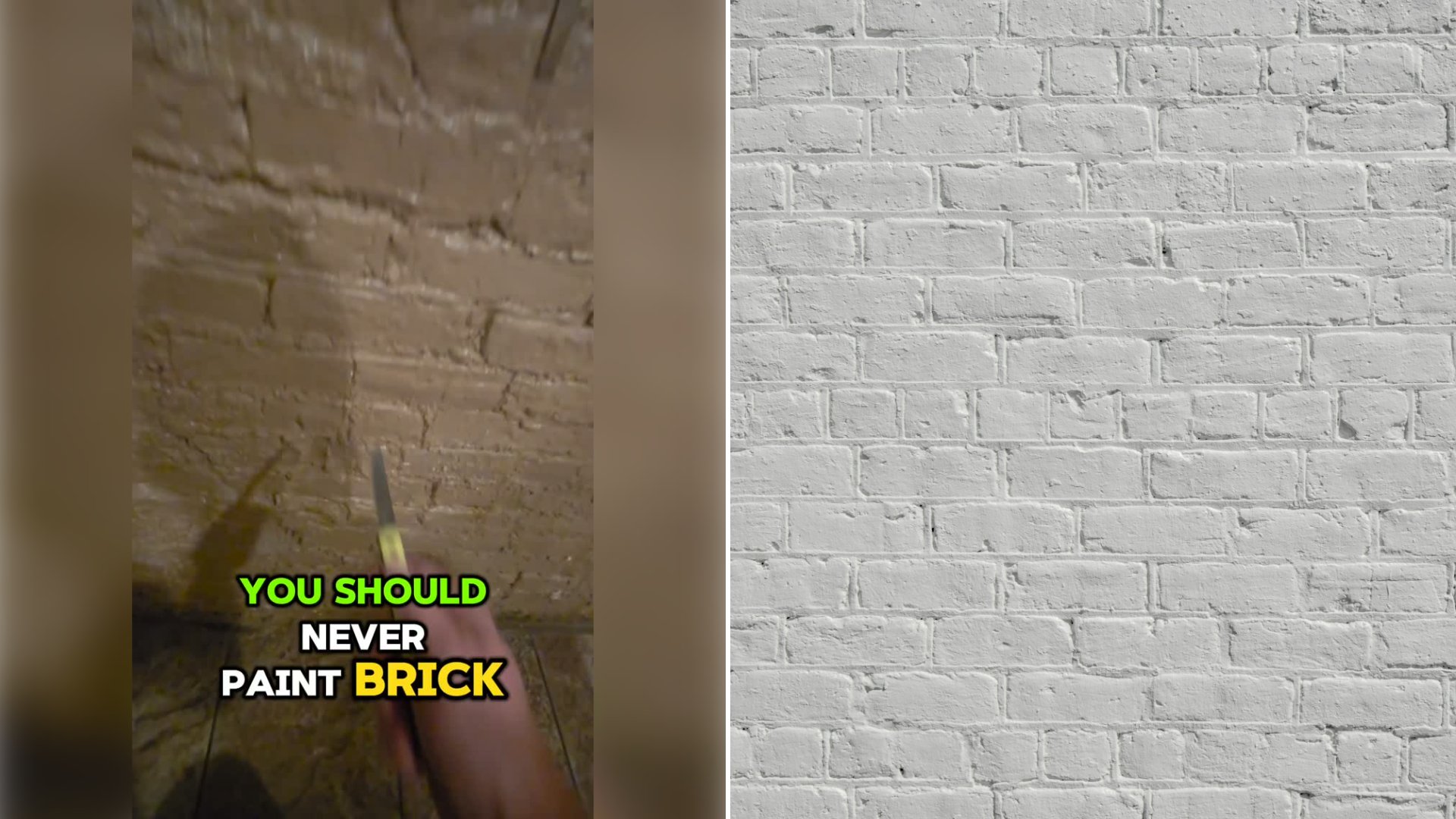
The caption on the reel from @homeinspector_saltlake is two words, “Poke poke.” The 25 second video is one continuous close shot of a tan, rough textured brick wall with the mortar lines showing, and a tattooed forearm pushing a yellow handled knife into it again and again. There is no face, no room and no house in the frame, only the wall, the knife and word by word captions in white and green letters.
Those captions carry the whole lesson. They begin, “You should never paint brick,” with the word brick highlighted in yellow. Then they continue, “If you do paint brick and you let the masonry get wet too often,” followed by a reaction line, “That’s brick, ladies and gentlemen.” The next lines read, “It is becoming butter,” and then, “Because they painted it, you know, this is what happens behind vinyl paint.”
The video does not say where the wall is, what kind of paint was used or how long it had been on, so the claim rests on the inspector’s say so and the knife. The inspector replied under his own post. He wrote that you can use a stain to change the color of bricks, and that any product which seals the open pores on the end of the brick and the mortar, such as an acrylic or latex based paint, will lead to issues like the one in the video.
The strongest pushback came from a commenter who says he has painted brick professionally for 25 years and told the inspector he had no idea what he was talking about, also questioning the term “vinyl paint.” A second commenter argued the knife was never in the brick at all, writing that it only went into the grout. A third wrote that it is not the brick dissolving but the mortar joints, which he said are more porous than the brick. Another asked what should be used on masonry instead, and one commenter answered with breathable stain sealer or limewash. These are the commenters’ views.
Federal preservation guidance bears on part of that debate. The National Park Service’s Preservation Brief 1, which is about cleaning historic masonry, says that water getting into a masonry building is “seldom due to porous masonry” and more often comes from leaking roofs, clogged gutters and missing mortar. It says a water repellent coating “should never be applied to a damp wall,” and warns that in the case of rising damp a coating “may force the moisture to go even higher in the wall.” It does not single out modern latex paint.
The brief also complicates the “never” in the video text. It notes that many buildings were painted when they were built or soon after, so keeping the paint can be the more appropriate choice historically. It also says some soft, underfired early brick may have become so porous that a coating is needed to protect it. And it points to the mortar side of the argument, saying lime mortar joints can be eroded by abrasive or mechanical cleaning, which can increase water penetration.
What the video does show is a knife entering a rough wall surface, and what the brief says is that soft brick and soft mortar can have more than one cause: a wall that stays wet, brick that was soft to begin with, or joints worn down by cleaning. A knife going in does not tell a homeowner which one they have.
For homeowners with brick, the useful steps come from that mix of views:
Before painting, fix the water source. Check roof edges, gutters, downspouts and missing mortar, since the National Park Service says those are the usual causes of moisture trouble, not the brick.
If you only want a new color, the inspector’s reply points to stain rather than a film forming paint.
If a wall is already painted and the surface is flaking or soft, have a mason or inspector check the mortar joints and the moisture level before repainting, and avoid blasting or grinding the joints during cleaning.
More from Willow and Hearth
- 8 Things a Seller’s Fresh Coat of Paint Might Be Covering Up
- House Flipper Tears Down a Wooden Panel Inside a Former Hoarder’s House as an Untouched 1958 Brick Fireplace Emerges to Become the Stunning Heart of the Renovation
- Homeowner Documents Visible Foundation Cracks in His New Build, Disputing the Builder’s Claim That Nothing’s Wrong
Leave a Reply