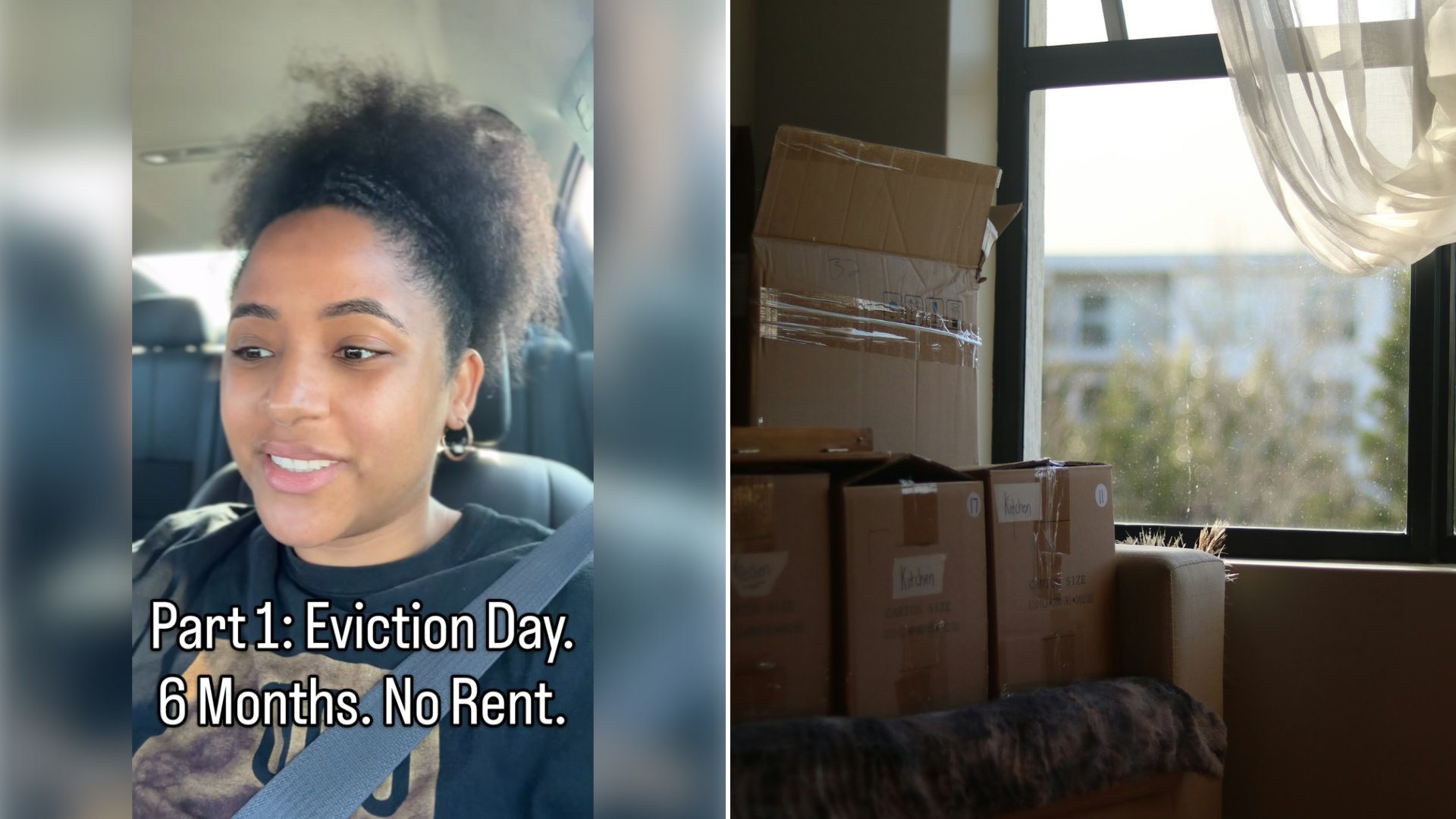
“After 6 months without receiving rent, it was finally eviction day.” That is how @inspirebytyler opens the caption on her reel. A title card runs across the bottom of the whole 110 second video: “Part 1: Eviction Day. 6 Months. No Rent.” For the first minute and a half she sits in a parked car with her hair up and a seatbelt across her shirt, talking to the camera, pushing a hand against her forehead, pointing and smiling at times, with the light shifting across her face as the minutes pass.
Near the end she turns the camera to the street. A white van and a dark pickup truck come down a residential road toward her, and a white patrol car follows with a gold star on the door that is marked Cook County. She films the car as it passes, with a person visible in the driver’s seat, then moves along a sidewalk, filming across a lawn toward a white house where figures in dark uniforms move near a dark SUV. The clip stops there. The caption adds: “This situation was stressful and a lot to mentally process, but it’s also a very real part of my real estate journey.”
The reel is labeled Part 1, so the outcome of the day is not in this video, and neither the caption nor the title card gives the address or names anyone. The Cook County marking on the patrol car is the only place clue in the footage. It is worth knowing how an eviction works there, because it differs from what many owners picture.
According to the Cook County Sheriff’s Office, the sheriff is the only entity that may carry out an eviction in the county, and the property owner needs a court issued order for possession before the sheriff will act. The office says it generally schedules evictions in the order they are filed and grouped by area, and that it calls the plaintiff or the plaintiff’s attorney one working day before to give the date and time block. The filing fee with the sheriff is $65 when filed online and $95 on paper at the Daley Center, and it is not refunded.
The tenant side is covered on the sheriff’s guide for people being evicted. It says enforcement can happen as soon as 24 hours after an order is placed with the office, that the sheriff mails a letter to the address on the order confirming a scheduled eviction, and that it does not announce the date or time to the tenant, citing officer safety. It also says that before any of this the landlord must serve a written termination notice, and that for unpaid rent a five day notice applies.
On the day itself, the office says a representative of the property owner must be present and meet deputies, who arrive in marked vehicles, outside the property. Uniformed deputies knock and announce themselves, may force entry under the court order if no one answers, and check that everyone named in the order has left. They then hand possession to the owner’s representative and post a No Trespassing notice on the door. If the eviction is called off at the site or the owner’s representative does not appear, a rescheduling fee of $65 or $95 applies before another date is set.
One point surprises many owners. The sheriff’s office says its personnel remove the people ordered out but do not remove or secure personal property, and that the owner and the tenant must arrange how belongings are retrieved. Locks are often changed once possession is returned.
Two commenters described their own experiences. One who says she got a nonpaying tenant out wrote that the tenant left by the court ordered date, so she did not need the sheriff, which she described as the more expensive route. Another who says she worked in property management for six years wrote that she has watched tenants react badly when removal day arrives, and that this is why she is turning down duplexes. Both are their own accounts of other situations.
For an owner of a rental, a few steps follow from the sheriff’s published process:
Find out which written notice your state requires for unpaid rent and how long its deadline runs, since in Illinois the sheriff’s guide says a five day notice applies and that paying within that window can prevent a case from being filed.
Wait for the court order and the sheriff. Do not change locks or remove a tenant’s belongings on your own, and plan who will be at the property on the scheduled day and who will handle what is left inside.
For a renter, the same guide lists a phone number for the sheriff’s social services department if you need relocation or financial help, and another to check whether a claimed eviction is real, since the office says falsely claiming to be a peace officer is a Class 4 felony.
More from Willow and Hearth
- Creator Documents a Chaotic Eviction Day That Ends With Her Moving Into a Camper
- Landlord’s Reaction After Evicting a ‘Tenant From Hell’ Is Caught on Camera the Moment He Walks In
- Sellers Are Increasingly Refusing to Move Out After Closing and Evicting Someone From a House You Now Legally Own Can Drag on for Months
Leave a Reply