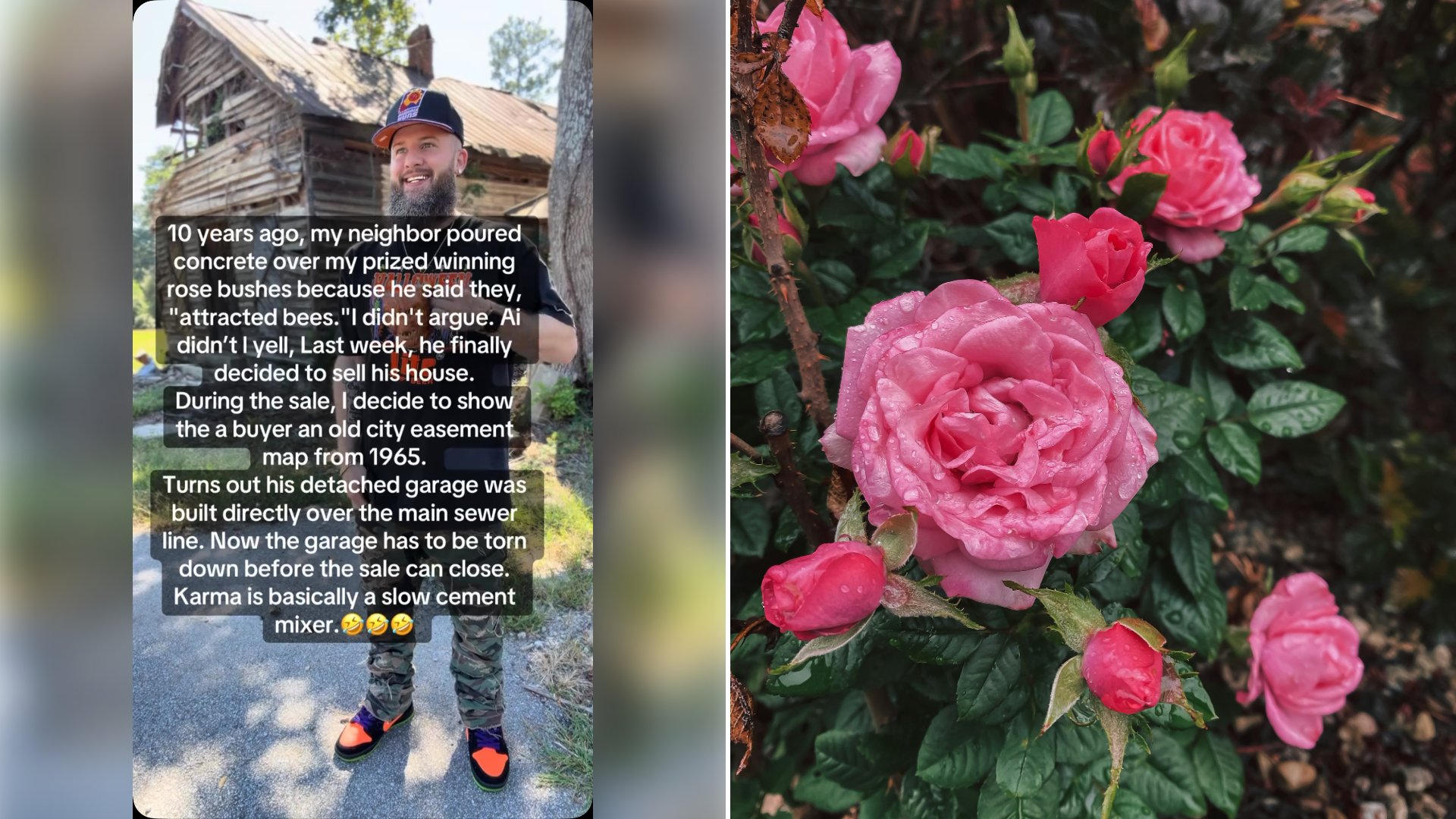
A six second reel from @theretrokid_ben turns one block of on screen text into a revenge story. A bearded man in a ball cap, a dark shirt, camouflage trousers and bright orange and purple sneakers stands on a gravel path in front of a weathered wooden building with a sloped roof. Early on he lifts a cup to his mouth and drinks, then lowers it and smiles at the camera while the text stays over his torso for the full length of the clip. The caption is the single word “Karma,” followed by hashtags that include #funny.
The overlay is written in the first person. It begins: “10 years ago, my neighbor poured concrete over my prized winning rose bushes because he said they, ‘attracted bees.’” The writer says he did not argue and did not yell. Last week, the text says, the neighbor finally decided to sell his house, and during the sale the writer decided to show a buyer an old city easement map from 1965. According to the text, the map showed that the neighbor’s detached garage was built directly over the main sewer line, so the garage has to be torn down before the sale can close. The last line reads, “Karma is basically a slow cement mixer.”
The post names no city, no state and no people, and it shows no map, no garage, no sewer line and no roses. The only scene is the man outside the wooden building, so the events are the creator’s account and nothing in the video confirms them. The #funny tag in the caption sits beside the story, which is how the story is best read.
The part of the story that touches real property rules is the easement. According to the San Francisco Public Utilities Commission, a city “must have an easement right to access the sewer main for maintenance, repair, or replacement.” The agency says owners generally may not unreasonably interfere with the easement holder’s use of the area or damage utility facilities there, that easements generally last indefinitely, and that they carry over when a property is sold. That last point is why an old recorded map can matter to a buyer decades after it was drawn.
The same agency says that if it needs to work in the easement area, existing structures may need to be removed, and that this is decided case by case. It adds that special features installed without its explicit written permission may be removed by the owner at no cost to the agency. It also says it will not release an easement unless the sewer main is no longer needed and has been properly decommissioned. These are the rules of one city’s utility, and a deed or recorded easement document is what governs a given lot.
The post does not say who ordered the garage torn down, or how a buyer came to see a map from 1965. One commenter wrote that the story was nonsense, arguing that a neighbor who intentionally damaged property and caused a financial loss would face criminal charges rather than a civil dispute. That is the commenter’s view, and the post does not say where it happened.
For homeowners and buyers, the useful steps do not depend on whether this particular story happened as told:
Before building a garage, shed, fence or addition, find out whether any recorded easements cross the lot. The San Francisco agency points owners to their title report, property deed or HOA covenants, conditions and restrictions, and says it will review that paperwork if a homeowner submits it to confirm an easement.
If a utility holds an easement, ask what it allows before you pour a foundation, and get any permission in writing. The agency asks owners to contact it before any new installation in the easement area other than non tree plants.
Know who pays. The agency says it performs sewer main work when there is complete documentation that the city accepted the easement area. If the documentation is insufficient, it says the owner must complete and pay for the work.
When you are buying, order a survey and read the easements listed in the title report before closing, since an easement stays with the land when it changes hands.
More from Willow and Hearth
- Homeowner Hires a Professional Surveyor After Suspecting His Neighbor Quietly Moved the Property Markers as the Definitive Proof Sets Up a Tense Confrontation Over the Stolen Lawn
- Doorbell Camera Captures a Tense, Awkward Standoff Between a Homeowner and His Neighbor Over a Barking Dog
- Homeowner Sets a Trap to Catch a Neighbor Who Keeps Trespassing in His Private Pool
Leave a Reply