Imagine signing the papers on a new home, budgeting carefully, and then watching the monthly homeowners association bill climb until it rivals a mortgage payment. That is the situation facing the residents of a small neighborhood in Sherrills Ford, North Carolina, according to realtor @kimsellsconcord, who says she could hardly believe she was recording the video.
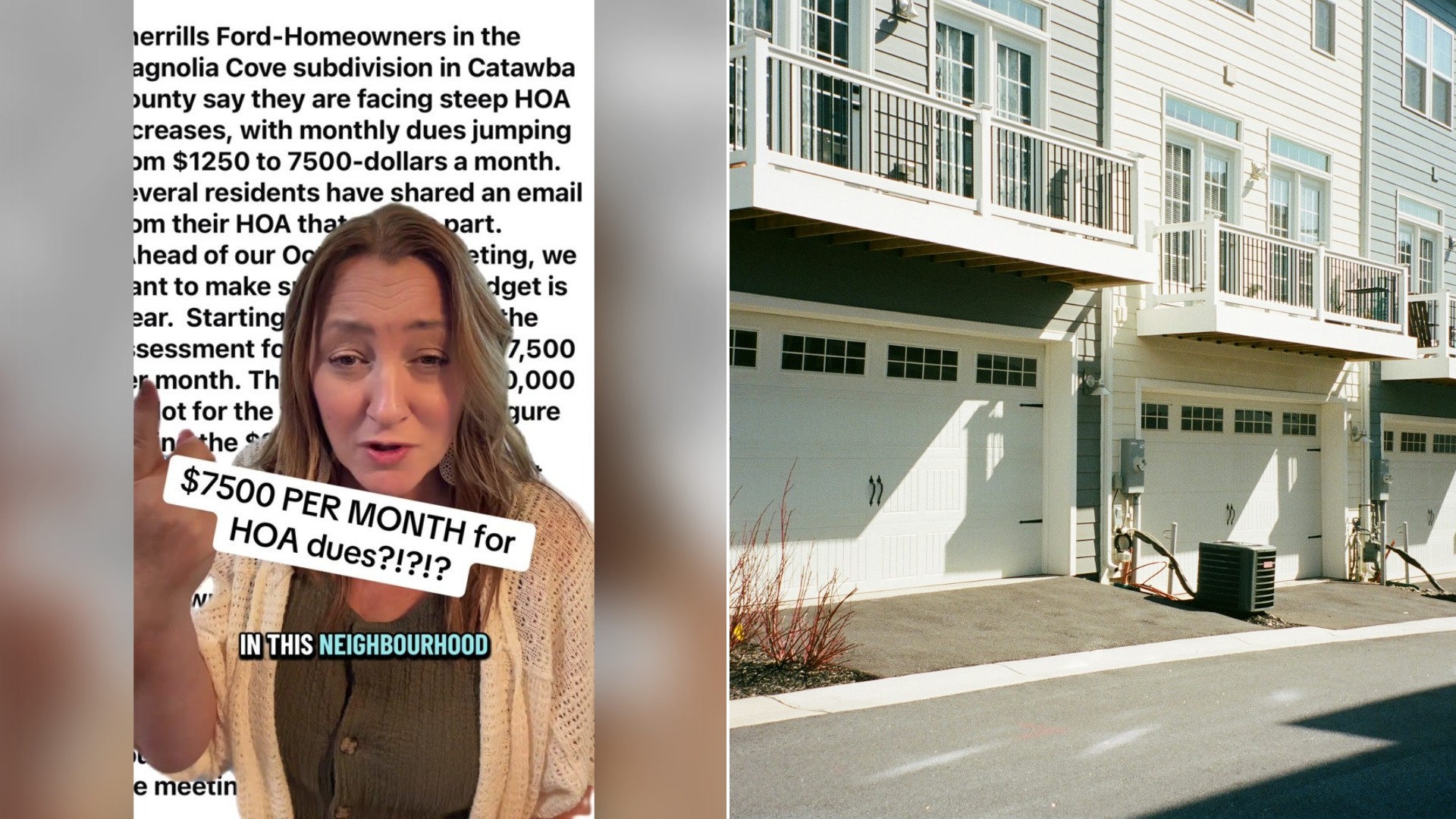
She describes a community where the homeowners association dues were about $158 a month when families first bought in. By her account, that figure covered lawn care, and the buyers were promised a pool. Today, she says, the dues have been pushed to levels that no one signing those original papers could have pictured.
Here is how she lays out the climb, step by step.
@kimsellsconcord
From $150 A Month To $2,500 A Month
The first jump, according to the realtor, took the dues from roughly $150 a month up to about $350 a month. The pool that buyers had been promised never showed up. Then, at the start of this year, she says the dues were raised again to $1,250 a month, and that increase came along with a $10,000 assessment on top.
The residents then received an email warning that the number was about to go much higher, a figure she reads out as $7,500 a month. She says the meeting took place the night before her video, and that the board of directors voted for $2,500 a month. Whichever way you slice it, that is a monthly bill many times larger than the one the families agreed to when they bought.
She points out that this is not a luxury enclave either. She describes it as a pricey community of homes, which makes a $2,500 monthly dues bill feel even more out of step with what the families were told to expect.
The Developer Still Holds The Board
The part that made her say “here is the kicker” is who controls the vote. She says the developer still runs the homeowners association and, as she understands it, owns most of the lots. Only 22 homeowners live in the neighborhood, and she says they do not get a vote on the increases.
As she tells it, the stated reasons for the hikes are that many people are not paying their dues and that legal fees have piled up. In other words, the shortfall created by unpaid dues and lawyer bills is being passed to the few residents who are paying, while the board that sets the number answers to the developer.
The homeowners did not sit quietly. She says they tried to reach North Carolina Attorney General Jeff Jackson. According to her, he told the news that no state statute limits how much a homeowners association can charge in fees, but that a board must comply with its governing documents. The residents counter that the developer controls the association, so there is no independent body to hold to those documents.
Why Selling Is Not An Easy Way Out
Because she is a realtor, the first thing she did was check the multiple listing service to see whether any homes in the neighborhood were for sale. She says there are listings, but she does not expect them to move. One home did sell, and she says it sold for a good deal less than what the owner originally paid.
Her reasoning is simple and any buyer would share it. Who is going to purchase into a neighborhood where the dues are $2,500 a month for what she calls nothing? She says that is why the families are stuck: they cannot sell at anything close to what they paid, and they cannot comfortably keep paying.
She lays out the worst case as she sees it. Homeowners who refuse to pay can have the association place a lien on their house, and from there they can slide into foreclosure. She says the residents have started a GoFundMe page to fight back, and she is hopeful the attorney general or someone else can step in. She says she plans to keep following the story.
What Every Buyer Should Know About HOA Dues
You do not have to live in North Carolina to learn from this. If you are shopping for a home in any community with an association, a few habits can protect you.
- Ask for the association budget and the last several years of dues history before you make an offer. A pattern of steady jumps is a warning sign.
- Find out who controls the board. In new communities the developer often holds control until enough lots are sold, and that matters when it is time to vote on money.
- Read the governing documents, sometimes called the declaration or covenants. Look for any language about special assessments and how large an increase the board can approve without a homeowner vote.
- Ask about reserves, unpaid dues and pending legal fees. As this story shows, collection problems can end up on the shoulders of the paying neighbors.
- Get promised amenities in writing, with a date. A pool that was pitched at the start and never built is exactly the type of thing to pin down before you sign.
It also pays to talk to neighbors before you buy. A few honest conversations on the sidewalk can tell you more about how an association behaves than any glossy brochure.
Associations can do real good, from keeping the common areas tidy to protecting property values. But the families in Sherrills Ford are a reminder that the fine print matters as much as the paint color. Dues that started near $150 a month and now stand at $2,500 a month, set by a board the residents cannot outvote, are the type of surprise nobody wants to open in an email.
The realtor closes with a promise to keep tracking what happens next, and with a hope that the owners find some way out. For now, the 22 households are waiting for answers, and anyone thinking about buying into a new development has a vivid lesson to carry along on the next open house.
More Stories You May Like
- Gardener Strips A Tomato Plant Down To One Leaf And Lays It Sideways In A Trench So The Stem Turns Into Roots And Grows Bigger Tomatoes
- She Spends $40 To $50 A Week Feeding Two Working Adults, And Turns Spoiling Tomatoes Into Sauce, Soft Fruit Into Jam And Scraps Into Broth
- Inspector Checks a Brand New Home Before the Drywall Goes Up and Finds the Bathtub Filled With Dirty Water, Sawdust and Construction Trash
Leave a Reply