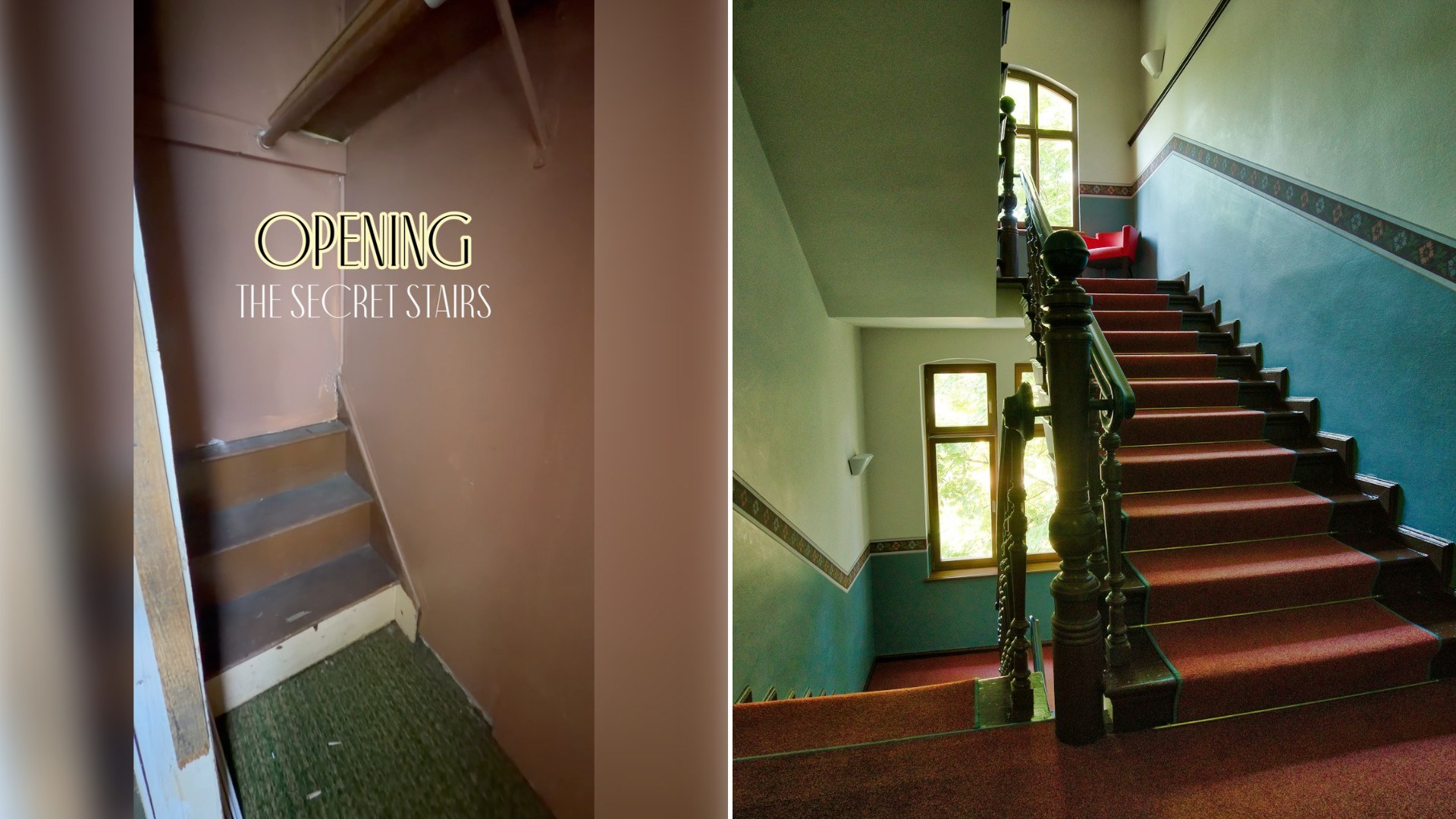
While renovating an old home, the creator demolishes a plain wall section to reveal a hidden, boarded-up staircase. The caption adds a neat historical detail — that a relative’s old shop teacher once lived in the house — discovered through the process, and documents clearing out the newly revealed stairs. There’s nothing staged about the setup here, just a straightforward premise that plays out exactly the way the caption promises, which is precisely why it’s resonated with the people who’ve seen it.
What makes a sealed-off staircase different from most other hidden-feature discoveries is the sheer scale of the decision behind it. Boarding over a closet or a window takes an afternoon; boarding over an entire stairwell means permanently changing how people move through a house, which suggests whoever did it wasn’t making a quick cosmetic fix but a deliberate, fairly drastic choice about how the home should function going forward.
View this post on Instagram
As @restoring_rory1920 tells it, the story is grounded in specifics rather than generalities, and that groundedness is exactly what separates a clip like this one from the more staged, aspirational content that tends to circulate in the same corners of social media.
A boarded-up staircase is a specific kind of discovery in an old house, different from finding a sealed closet or a bricked-over fireplace, because a staircase implies an entire portion of the home’s original circulation was deliberately cut off, not just a single feature hidden behind drywall. Someone, at some point, decided that an entire path between floors was no longer needed, or no longer wanted, and chose to seal it rather than simply stop using it.
The detail about a relative’s old shop teacher having once lived in the house does more narrative work than it might first appear. It transforms an anonymous old structure into a specific, traceable place with a name attached to its past, and it gives the creator a personal thread to follow, turning what could have been a purely cosmetic demo update into something closer to a small piece of local history being pieced back together room by room.
Houses old enough to have had staircases boarded up rather than simply removed often went through multiple rounds of use changes over the decades, a single-family home converted into a rental, a rental split into separate units, or a floor plan reworked entirely to suit a owner’s changing needs. A staircase that no longer served the current layout would have been a logical thing to seal off rather than demolish outright, since removing it entirely would have meant far more structural work than simply boxing it in.
Clearing out a staircase that’s been sealed for an unknown number of years is its own distinct task from the demolition that revealed it, since whatever debris, dust, or forgotten objects accumulated in that enclosed space over the decades has to be dealt with before the stairs can be usable again. That cleanup phase rarely gets the same attention as the initial reveal, even though it’s often the less glamorous, more time-consuming half of the actual work.
For anyone restoring an old home, a find like this one is also a reminder to treat plain, unremarkable-looking walls with a bit of suspicion rather than assuming they’ve always served the same purpose. A wall that looks structural or decorative on the surface can just as easily be concealing an entire architectural feature that a previous owner decided, for reasons lost to time, was better sealed away than kept in use.
Comment sections under restoration videos like this one tend to fill with people sharing their own stories of discovering hidden features in old houses, bricked-up windows, sealed closets, forgotten root cellars, a pattern that suggests this kind of concealment was far more common across older housing stock than most current owners realize until they start tearing into their own walls.
Whatever this particular staircase eventually leads to once it’s fully restored, the discovery has already given this renovation a story that connects the house’s present back to its own layered, half-forgotten past, exactly the kind of detail that turns a routine demo day into something worth documenting.
There’s also something worth sitting with in how the shop-teacher detail surfaced at all. Family stories about who used to live where tend to fade fast once a property changes hands a few times, and it’s easy to imagine this particular connection going unmentioned entirely if a relative hadn’t happened to recognize the address once the renovation started making the rounds online. That near-miss is part of what makes the detail feel less like trivia and more like a small, almost accidental act of preservation.
Old houses accumulate these kinds of half-documented histories in layers, one owner’s choices stacked on top of the last, and a renovation like this one is as much an exercise in excavation as it is in rebuilding. Every wall that comes down carries the possibility of surfacing a decision someone made decades ago for reasons that may never be fully known, which is part of why restoration accounts like this one tend to hold an audience’s attention even when the actual work being shown is as unglamorous as hauling debris out of a reopened stairwell. Few renovation moments make that layered history as literal as a staircase that someone, at some point, chose to wall off entirely, and fewer still come with a personal connection like a family’s old shop teacher attached to make it feel this close to home.
Leave a Reply