A Talk Show Legend’s Other Legacy
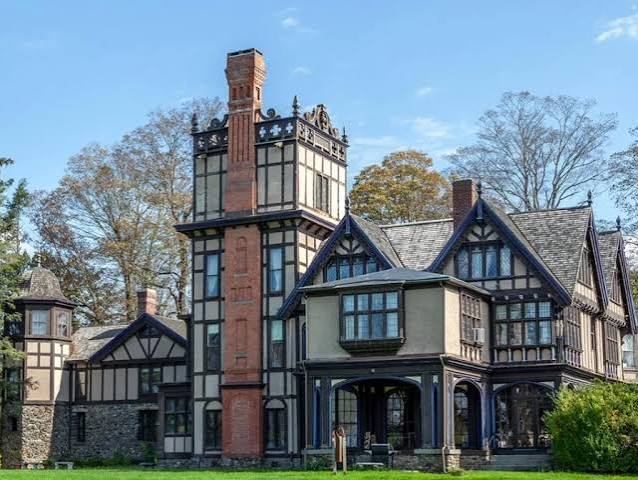
Before she became one of daytime television’s most recognizable faces behind those signature red-framed glasses, Sally Jessy Raphael was already building a second life eighty miles north of Manhattan. In 1997, she and her late husband, Karl Soderlund, bought Elmwood Farm, a sprawling Elizabethan-style estate on Quaker Hill Road in Pawling, New York, according to Patch. Nearly three decades later, that estate is on the market for $6.5 million, and the listing reads less like a real estate description and more like a walking tour of American architectural history.
The property spans roughly 25 acres and includes a 43-room main house of about 15,000 square feet, with 17 bedrooms and 13 bathrooms split between full and half baths, according to Robb Report. To put that room count in perspective: a buyer determined to see the entire main house on move-in day, spending even two unhurried minutes per room, would need well over ninety minutes just to walk through the house itself, before ever setting foot on the surrounding grounds.
A House That Survived a Fire and Rebuilt Itself Twice
The estate’s history goes back further than its current Tudor Revival appearance suggests. The original house on the property was built by John Akin around 1796, but a fire destroyed it in February 1872. Frances Akin Gould rebuilt the home by the mid-1880s, and it passed to Beulah Gould Branch and John Kerr Branch starting in 1886, according to Brownstoner. Starting around 1900, architect Edward Lee Young transformed the rebuilt structure into the Tudor Revival mansion that stands today, working around the original foundations while adding the dramatic brick chimney, half-timbering, and towers — a square one on the main facade, an octagonal one on a side wing — that now define the house’s silhouette. Detailed interior carving and finishing work reportedly continued through at least 1912.
That century-plus of layered construction shows up in details a modern architect would be hard-pressed to replicate at any price. There’s a grand oak staircase built around 30 hand-carved newel posts, each one carrying its own whimsical animal design, according to Patch’s reporting. A second-floor wing displays hand-painted storybook murals. Stained and leaded glass windows catch the light throughout the main rooms, and ten separate fireplaces are scattered across the house’s three stories. Outside, a porte-cochère entrance and a Gothic-inspired barn entrance round out a property that reads more like a small institution than a private residence.
More Than a House
Elmwood Farm isn’t just the main house. The grounds include two separate caretaker dwellings, a carriage house with its own groom’s quarters, a roughly 12,000-square-foot stable complex, a yoga studio, and a greenhouse, per Patch. There’s also an elevator inside the main house, a patio, and a pool — practical modern conveniences tucked into a property whose bones are more than two centuries old. The listing is held by Harriet Norris of Douglas Elliman.
This isn’t the first time the estate has come to market during Raphael’s ownership; Brownstoner and other outlets have tracked the listing being relisted with adjustments to price and acreage over recent years, reflecting both the challenge of finding a buyer for a property this specific and Raphael’s own evolving relationship with a home she’s kept for close to thirty years.
What makes Elmwood Farm worth pausing on isn’t just its scale, though the scale is genuinely hard to overstate for a private home. It’s the way the property compresses more than 225 years of American domestic history into a single, walkable — if barely walkable in an afternoon — piece of land. A buyer who takes on Elmwood Farm isn’t just buying square footage; they’re taking custody of a rebuilding project that started after an 1872 fire, was reimagined by a Gilded Age architect, sheltered a beloved television host and her family for a generation, and is now waiting for whoever has both the acreage requirements and the patience for ten fireplaces to become its next chapter.
Who Actually Buys a House Like This
Properties on the scale of Elmwood Farm rarely sell to a typical move-up buyer looking for more bedrooms. Estates this size and this historically layered tend to attract institutional buyers weighing a conversion to a boutique hotel or event venue, conservation-minded owners drawn to the century-plus of documented architectural history, or a small pool of private buyers who specifically want the isolation and scale that only a 25-acre Hudson Valley property can offer within reasonable driving distance of Manhattan. Pawling’s location, close enough for a weekend retreat but far enough to feel fully removed from the city, is as much a part of the pitch as the ten fireplaces themselves.
Leave a Reply