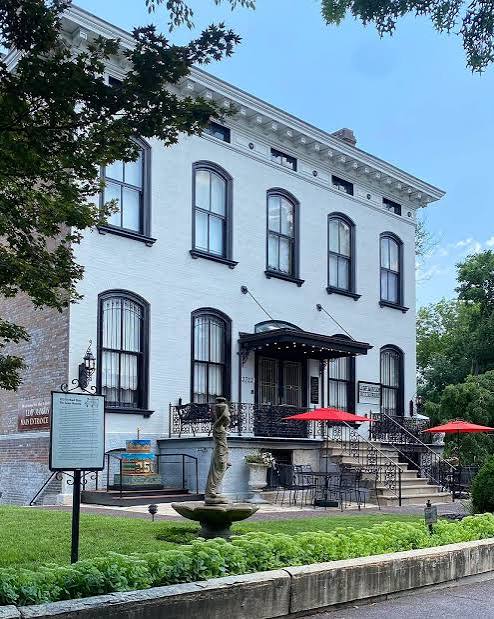
The Lemp Mansion in St. Louis’s Benton Park neighborhood is back on the market, listed at $3.9 million with the adjoining Lemp Stables offered separately at $2.8 million, according to both St. Louis Public Radio and KSDK. The mansion’s reputation as one of the most haunted addresses in the country didn’t come from a marketing team. It came from an actual family, and an actual, well-documented run of tragedy that unfolded inside its walls across three generations.
A brewing fortune and four suicides
The house at 3322 South 13th Street was built in the early 1860s by a baker named Jacob Feickert and expanded in 1876 by William J. Lemp Sr., whose family had built one of the largest breweries in the country before Prohibition forced it to close. The tragedy started, by most accounts, with the mysterious 1901 death of William Sr.’s son and heir, Frederick Lemp. What followed was four suicides inside the family across three generations: William Lemp Sr. in 1904, his daughter Elsa Lemp Wright in 1920, William Lemp Jr. in 1922, and Charles Lemp in 1949. It’s rare for a “haunted house” story to have this much documented, verifiable grief behind it rather than invented lore, and it’s part of why the Lemp name still carries weight in St. Louis more than a century later.
From family home to restaurant, inn, and ghost tour destination
The Pointer family has owned and operated the mansion for roughly five decades, turning it in the 1970s into a working restaurant, inn, and event venue that also became one of the city’s best-known paranormal tourism stops, complete with ghost tours built around the family’s history. The 33-room, 7,300-square-foot house still holds African mahogany trim and hand-carved Italian marble mantels from the Lemp era, along with an underground tunnel that once connected the property to the brewery’s caves. According to STLPR, the Pointers decided to sell now because the caretakers who have run the business for years are approaching retirement, not because the business itself is struggling.
A sale that comes with strings attached
Brokers Brian Besse and Kim Wright of Fusion Business Brokers are handling the listing, and both prices include the turnkey restaurant and event-venue operations already running on site, not just the buildings. All of the antiques inside are staying with the property, and existing bookings for weddings and other events already on the calendar will be honored under new ownership. The mansion also sits inside the Cherokee-Lemp Historic District on the National Register of Historic Places, which limits what any future owner can change about its exterior, meaning this isn’t really a sale of raw real estate. It’s a sale of an ongoing, historically protected business that happens to double as one of the most recognizable haunted addresses in the Midwest.
The brokers have said what they’re looking for isn’t necessarily the highest bidder, but someone who will treat the building the way the Pointer family has, according to the listing team’s own comments to local outlets. That’s a notable ask for a commercial sale of this size, and it reflects how much of the mansion’s value is tied up in things a spreadsheet can’t easily price: five decades of continuity, a staff that knows the building’s history well enough to lead ghost tours through it, and a reputation carefully built rather than manufactured. A buyer who guts the restaurant or strips the antiques to flip the property for parts would be working against the exact thing that made the listing newsworthy in the first place.
Reporting on the asking price has varied slightly across outlets covering the listing, with some early write-ups citing a lower figure for the mansion alone; the $3.9 million figure used here reflects the number confirmed independently by both STLPR and KSDK, and it lines up with other local coverage describing a combined price for the mansion and stables at just under $4 million.
A landmark St. Louis has learned to live alongside
Unlike a lot of reputedly haunted properties that trade almost entirely on rumor, the Lemp Mansion has spent decades operating in plain sight as a functioning business, hosting weddings, Sunday dinners, and mystery-theater nights in the same rooms where the family’s documented deaths took place. That dual identity, equal parts historic site and working restaurant, is likely why the mansion has survived intact instead of being subdivided or demolished the way so much of the surrounding brewery complex eventually was. Whatever the final sale price ends up being, the Lemp Mansion’s value was never really about square footage. It’s about a century-old story that St. Louis has never stopped telling, and that the next owner will now be responsible for keeping alive.
Leave a Reply