
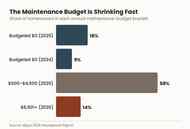
Eighteen percent of U.S. homeowners now budget nothing at all for home maintenance, roughly double the 9% who said the same one year earlier, according to Hippo Insurance’s fourth annual Housepower Report, released in early 2026. That’s not a small shift. It means the share of people planning to handle whatever breaks with zero dedicated savings nearly doubled in a single year, right as the same report found unexpected repairs are the single most common home-related expense knocking people’s finances off track. Put those two numbers next to each other and a fairly stark pattern shows up: the group of homeowners with no cushion is growing fastest at exactly the moment surprise costs are hitting hardest.
The Middle Bracket Is Absorbing Everyone
It isn’t just the $0 group that shifted. Hippo’s data shows 58% of homeowners now budget in the $500-to-$4,500 range annually, up sharply from 39% the year before, while the share budgeting $6,501 or more collapsed from 35% down to just 14%. Read together, those three numbers describe a squeeze rather than a single trend: homeowners who used to keep a larger maintenance reserve are pulling back into a tighter middle bracket, and a growing slice are opting out of budgeting altogether. Almost nobody moved up.
Unexpected Repairs Are the Trigger
Hippo’s report found that 76% of U.S. homeowners experienced at least one home-related issue affecting their financial stability in the past year, and unexpected repair costs topped the list of specific concerns across every age group surveyed, with 33% saying surprise repair costs directly hurt their financial stability. That’s the mechanism worth paying attention to: it’s not that homeowners are choosing to under-budget out of confidence everything will be fine. It’s that a wave of surprise expenses appears to be pushing people toward either a smaller, tighter budget or none at all, since a maintenance line item only helps if the money survives long enough to cover the emergency it was meant for.
The DIY Response Doesn’t Fully Close the Gap
More than eight in ten homeowners told Hippo they intend to take on DIY maintenance work as a way to manage costs, but only 34% said they actually feel confident completing basic DIY projects themselves. That gap between intention and confidence matters, because a homeowner who tackles a repair without the skill to match risks turning a maintenance item into the kind of costly correction job that shows up elsewhere in the same data: bigger bills, not smaller ones. The top reasons people gave for going the DIY route were straightforward: 57% cited saving money, 36% cited personal accomplishment, and 30% wanted more control over the outcome, which reads less like enthusiasm and more like financial pressure wearing a hobbyist’s face.
What a Shrinking Budget Actually Buys
A maintenance budget isn’t a luxury line item; it’s what keeps a $300 repair from turning into a $3,000 one by catching problems early instead of after they compound. Roof flashing, water heater sediment, HVAC filter changes, and gutter clogs are all cheap to address on a schedule and expensive to ignore until they fail outright. When 18% of homeowners are budgeting zero dollars for any of that, a larger share of ordinary wear-and-tear repairs graduate into full-blown emergencies, which is likely part of why the same report found unexpected costs rising as a source of financial stress in the first place.
An Aging Housing Stock Makes the Timing Worse
This budget pullback is arriving at an inconvenient moment for the housing stock itself. The median owner-occupied home in the U.S. is now 42 years old, up from 31 in 2005, and homes at least 45 years old have grown from 39% of the market in 2014 to 47% in 2024, according to NAHB’s Eye on Housing analysis of Census data. Older systems fail more often and more expensively: roofs, water heaters, and HVAC units all have finite lifespans, and a house built in the 1980s is carrying original or once-replaced infrastructure that a newer build simply isn’t. A shrinking maintenance budget and an aging housing stock moving in opposite directions is exactly the kind of mismatch that shows up later as the “unexpected” repair everyone keeps citing as their top financial stressor.
The pattern underneath these numbers isn’t really about homeowners getting careless. It’s a feedback loop: rising surprise costs are shrinking maintenance budgets, and shrinking maintenance budgets are very likely setting up the next round of surprise costs, with an entire fifth of homeowners now going in with no plan at all.
Leave a Reply