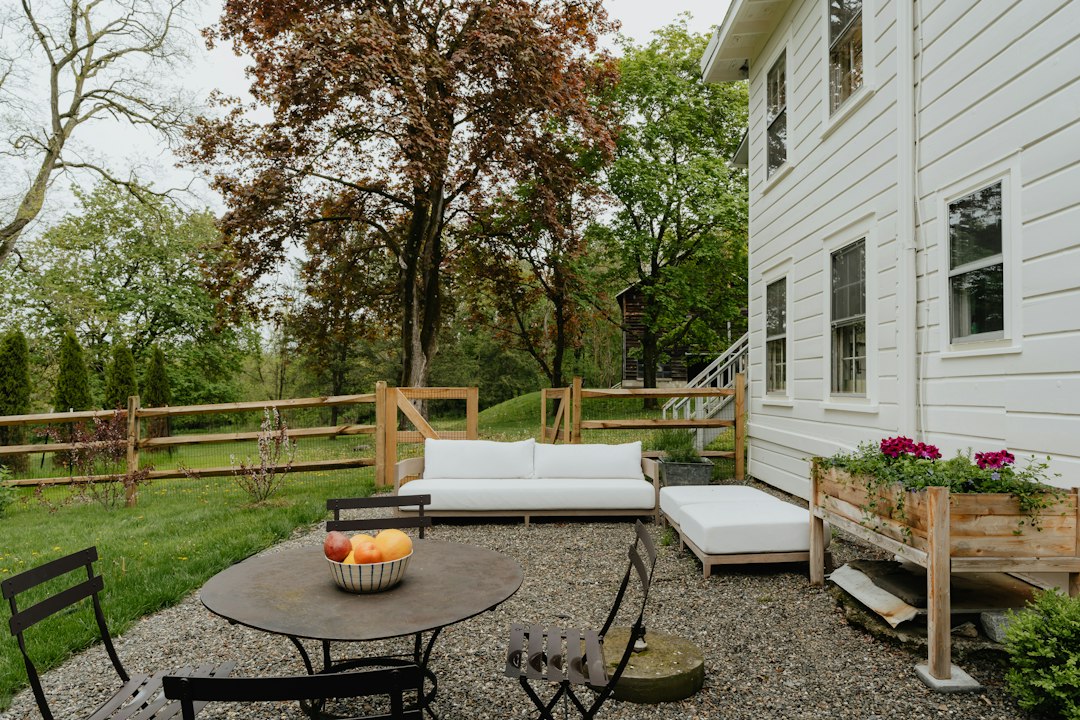
Backyards are notoriously hard to photograph honestly. Unlike a bedroom or kitchen, there’s no doorway or hallway forcing a fixed vantage point — a photographer can stand almost anywhere, use almost any lens, and shoot at almost any time of day to make an outdoor space look larger and lusher than it is.
None of this is necessarily deceptive, but it does mean backyards deserve a healthy dose of skepticism until you’ve walked the actual perimeter yourself. Here’s what tends to inflate a backyard’s apparent size in photos.
Wide-angle lenses shot from a high corner
Photographers often shoot backyards from an elevated angle in a far corner, using a wide lens that captures far more depth and width than the human eye perceives while standing in the space. This single choice is probably responsible for more backyard disappointment than any other trick in real estate photography, since it visually stretches a modest rectangle into something that reads as expansive.
Drone shots that flatten depth perception
An aerial photo is useful for understanding a lot’s shape, but it’s terrible for understanding how a yard actually feels to stand in. From above, a narrow side yard and a spacious back patio can look like one continuous, generous space, when in reality they’re separated by fences, gates, or awkward pinch points you’d only notice at ground level.
Minimal furniture, maximized open space
A backyard staged with just a small bistro set or a single lounge chair will always look roomier than one furnished for actual daily use. Picture the space with a real dining set, a grill, maybe a play structure or a dog run, and ask yourself honestly whether it would still feel spacious with everything you’d actually want out there.
Strategic cropping of fences and neighboring structures
Photos are composed to avoid the neighbor’s shed, a utility pole, or a fence that’s noticeably close to the house. In person, that proximity is often the first thing you notice, and it can make a yard feel boxed-in in a way that a carefully framed photo never suggested.
Landscaping that draws the eye outward
Tall grasses, mature trees at the property line, or a winding garden path can visually extend a yard’s sense of depth well beyond its actual boundaries. These same features, once you’re standing in the space, often turn out to mark exactly where the property ends — sometimes much closer than the photo implied.
Golden-hour lighting and a wide sky
Photos shot at sunrise or sunset with a wide expanse of sky in the frame create a feeling of openness that has nothing to do with the yard’s actual square footage. A small backyard photographed under a dramatic sunset can look far more inviting and expansive than the same space does under the flat light of a midday showing.
No reference point for scale
Without a person, a piece of furniture of known size, or a fence of standard height in frame, it’s genuinely difficult to judge a yard’s dimensions from a photo alone. Always check the listing’s lot size in square feet and, if you can, compare it to a space you already know well — your current yard, a local park, a parking lot — to get a realistic sense of scale before you visit in person.
Leave a Reply