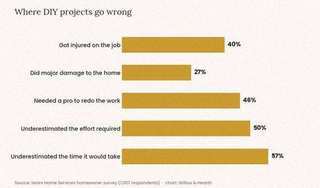
Fifty-seven percent of DIY homeowners underestimated how long their project would actually take, and 50% underestimated the effort it would require, according to a Sears Home Services survey of over 1,000 homeowners. Those aren’t small misses on a weekend paint job. They’re consistent enough to show up as the top complaint in the entire survey. A separate homeowner survey from Hippo Insurance found a similar pattern from a different angle: 47% underestimated the time commitment and 58% ended up spending more than planned because of mistakes along the way. Two surveys, two different companies, the same story: most people planning a DIY project are working from a timeline that has almost nothing to do with how the project will actually go.
The projects that blow up estimates the worst
The Sears data breaks down which categories homeowners felt confident tackling versus which they avoided outright, and the gap tells you where time estimates go wrong. Running a gas line, repairing a roof, and installing new windows were the projects homeowners were least confident about: 55%, 47%, and 44% respectively said they lacked confidence to even attempt them. But confidence didn’t protect the projects people did attempt: deck waterproofing and under-cabinet lighting installation were rated as jobs homeowners felt confident about, yet both appeared among the most frequently botched projects, with roughly 17% of under-cabinet lighting attempts ending in a negative outcome. Confidence and competence turned out to be two different things.
Why the estimate gap happens
Most DIY time estimates come from a YouTube video or a big-box store demo, both of which show the ideal version of a project: right tools already in hand, no surprise behind the wall, no return trip to the hardware store for the one fitting that doesn’t match. Real projects hit friction points that never make it into a 12-minute tutorial: a stud that isn’t where the stud finder said it would be, a fastener that strips on the third turn, an electrical box that’s a different depth than the replacement part expects. Each of those adds 20 minutes that doesn’t show up in anyone’s estimate, and they compound. A project scoped as a two-hour job becomes a Saturday, and a Saturday job becomes a project that eats into Sunday too.
What the failure numbers cost
The consequences run past lost time. Sears found that 46% of DIY homeowners needed a professional to redo work they’d already attempted, at an average added cost of $1,600, money that would have gone toward hiring a professional in the first place, plus whatever materials were wasted on the first attempt. The same survey found 40% of DIYers with experience reported getting injured during a project, and 27% said they’d done major damage to their home in the process. Underestimating time isn’t just an inconvenience; it’s the same mental error that leads people to keep pushing on a project after fatigue sets in, which is when both injuries and costly mistakes cluster.
The fix isn’t complicated, even if it runs against instinct: take whatever time estimate feels right for a project and treat it as the floor, not the target. If a job “should” take three hours, block out a full day and consider anything finished early a bonus. Sears’ own data suggests building in a buffer for at least one unplanned trip to the hardware store, because the survey’s numbers say that trip is closer to inevitable than exceptional.
A better way to scope a project before starting
One habit that narrows the estimate gap: before buying materials, physically open up or expose whatever the project touches (pull the outlet cover, peek behind the trim, check what’s actually behind the tile) rather than estimating from a diagram or a stock photo of a “typical” installation. A large share of the time overruns in the Sears and Hippo data trace back to homeowners discovering mid-project that their situation wasn’t the standard case the tutorial assumed: wiring from a different decade, a stud pattern that doesn’t match code, a fitting size that was discontinued years ago. Finding that out during a ten-minute inspection costs you ten minutes. Finding it out with the wall already open costs you the rest of the weekend.
What both surveys really capture is a planning bias that has nothing to do with skill level — plenty of experienced DIYers still misjudge their own projects, because the bias lives in how humans estimate any unfamiliar task, not in how much practice they’ve had.
Leave a Reply