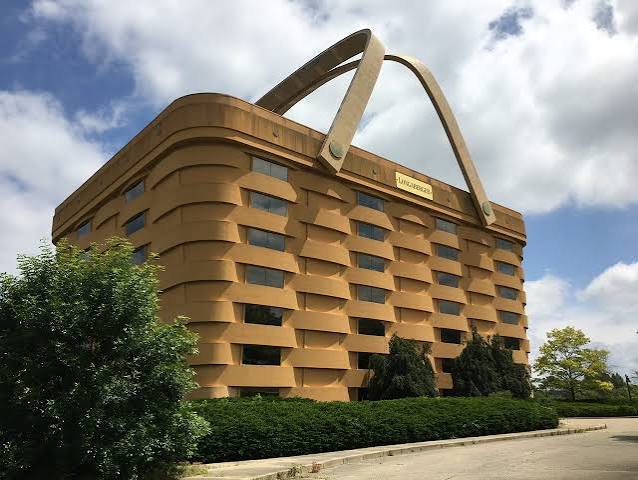
Outside Newark, Ohio sits a seven-story office building shaped like a giant picnic basket, complete with two oversized handles arching 192 feet over the roofline, and it is now listed for sale at $8.5 million. The building was the corporate headquarters of the Longaberger Company, and according to Smithsonian Magazine, whoever buys it comes with a condition attached that has nothing to do with financing.
A basket company that built an actual basket
Longaberger was founded in 1973 as a family basket-weaving business, and by 2000 it had become genuinely enormous: 11 million handwoven baskets sold in a single year, more than $1 billion in annual sales, and over 8,000 people on payroll at its peak, according to NBC4. Company founder Dave Longaberger wanted a headquarters that reflected the product, so in 1997 the company built one: 180,000 square feet across seven stories, built to the exact proportions of the company’s medium market basket, with an exterior of painted stucco over wire mesh and two massive basket handles running the length of the roof, complete with internal heating elements so they wouldn’t accumulate ice in Ohio winters. Inside, the building has a cherry wood staircase atrium, glass elevators, a gym, and a media room, and it once held roughly 500 corporate employees on a 21.5-acre campus.
From bankruptcy to a $1.2 million bargain to $8.5 million
The company that built the basket didn’t survive to keep it. Longaberger folded in 2018, following years of declining sales and debt, and the headquarters sat largely dormant until developer Steve Coon bought it in 2017 for roughly $1.2 million, according to Yahoo Finance. Coon has spent the years since trying to find the building a new purpose, and he’s now asking $8.5 million for a property he paid a fraction of that for less than a decade ago, a number that reflects less the real estate market around Newark and more the sheer cost and difficulty of maintaining a building nobody else in the country has ever tried to build again.
The basket building was never the company’s only oddity. At its height, Longaberger also ran a golf club, a hotel, manufacturing plants, and a complex called the Homestead that featured its own attraction: the World’s Largest Apple Basket, a nod to the same design philosophy applied at a smaller scale elsewhere on the property. Most of that footprint has since been sold off piecemeal or shuttered, which is part of why the headquarters building has become the single most recognizable piece of what Longaberger left behind, the one landmark still standing that anyone driving past on Route 16 would immediately recognize.
The catch: it has to stay a basket
Coon has reportedly turned down previous offers from buyers who wanted to strip the handles or otherwise normalize the building’s appearance. His condition for selling, in his own words, is blunt: “It’s got to stay a basket or I won’t sell it.” That single requirement narrows the buyer pool considerably. Whoever purchases the Longaberger headquarters isn’t just buying 180,000 square feet of office space near Columbus; they’re buying the upkeep of a landmark that draws tourists and social media attention specifically because it looks nothing like a normal building, and they’re agreeing to keep it that way. Coon has also said he hopes the eventual buyer will pursue National Register of Historic Places designation, a status that would formally protect the building’s oddity rather than merely tolerate it, according to listing agent Brandon Hess of Shai Hess Real Estate, who is handling the sale.
It’s a strange kind of preservation fight, arguing for the historic value of a building that’s less than 30 years old, but the Longaberger basket has already outlived the company that built it, and outlived at least one attempt to quietly let it become just another empty Ohio office park. Whether it survives as a hotel, a museum, or something nobody has thought of yet, the building’s next chapter comes with a rule already written into the sale: it has to keep looking exactly like what it is.
Local coverage of the listing, including reporting from ABC6 in Columbus, has noted that the building draws a steady stream of curious visitors even with no active tenant inside, people who pull off the highway just to photograph the handles up close. That kind of organic foot traffic is unusual for a vacant commercial property, and it’s likely part of what Coon is banking on: a buyer willing to treat the novelty as an asset rather than a liability, whether that means converting the space into a boutique hotel, an event venue, or a corporate headquarters for a company that wants exactly the kind of attention a seven-story picnic basket generates for free. For a town the size of Newark, losing the basket building to demolition or an anonymous facade change would mean losing one of the only landmarks most Americans could actually place on a map.
Leave a Reply