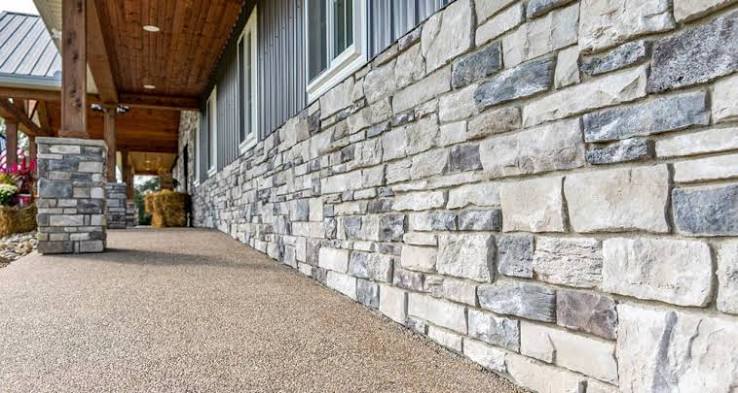
A manufactured stone veneer project costing $11,702 returns $24,328 in added resale value, a 207.9% cost-recouped rate that ranks third among every remodeling project Zonda’s 38th Annual Cost vs. Value Report tracks nationally. That return more than doubles what homeowners recoup on a minor kitchen remodel, long treated as the benchmark for interior renovation payback, which posts 112.9% in the same 2025 dataset. It also outpaces full fiber-cement siding replacement, at 113.7%, and vinyl siding replacement, at 96.5%, despite covering only a fraction of a home’s exterior wall area. The gap comes down to where the stone actually goes and how little square footage it takes to move a buyer’s first impression.
What the project actually involves
Manufactured stone veneer isn’t cut from a quarry. It’s lightweight, molded concrete cast in rubber forms and pigmented to read as ledgestone, fieldstone, or brick, then adhered directly over a water-resistant barrier and metal lath on the existing wall surface. Because it’s a facing material rather than a structural one, installers apply it only where it will be seen: the lower third of a front facade, a foundation line, an entry surround, porch columns, or the base of a chimney. A typical job covers somewhere between 200 and 400 square feet, a small share of the 1,500 to 2,500 square feet of wall a full residing project would touch. That narrower scope is what keeps the average job cost under $12,000 rather than climbing toward the $18,000 to $21,000 range full siding replacement commands, while still delivering a complete material and color change at the one part of a house every visitor and every prospective buyer sees first.
Why it performs so well on resale
The return isn’t just about being cheap. It’s about precision. Real estate agents overwhelmingly treat the front entry as the deciding factor in a buyer’s first impression, and the National Association of Realtors’ Remodeling Impact Report finds that 97% of agents consider curb appeal important to attracting buyers, with 92% actively advising sellers to improve it before listing. A stone accent at the entry concentrates the entire renovation budget on that exact sightline instead of spreading it thin across four elevations most buyers never walk around to see.
There’s also a perception effect at work. Stone veneer applied selectively reads as a deliberate design decision, the kind of upgrade a homeowner chose rather than one they were forced into. Full siding replacement, by contrast, tends to get read by buyers and appraisers alike as deferred maintenance finally addressed, closer to a new roof or a repaired foundation than a design statement. Both add value, but only one of them looks like an upgrade rather than a repair, and that distinction shows up directly in the appraisal math.
How it compares to full siding replacement
The Zonda data makes the contrast concrete. Fiber-cement siding replacement costs an average of $21,485 and returns $24,420 at resale, a 113.7% recoup rate. Vinyl siding replacement costs $17,950 and returns $17,313, just 96.5%, meaning most homeowners who reside a house in vinyl don’t fully recover the expense at sale. Both projects cover the entire exterior envelope, involve tear-off and disposal, and typically take one to two weeks longer than a targeted veneer application. Manufactured stone veneer, doing a fraction of the work at roughly half the cost, still out-returns both. Doing more of a house doesn’t scale the payoff proportionally. In this case, doing less, in the right spot, outperforms doing all of it.
That pattern extends beyond siding. The two projects Zonda ranks above manufactured stone veneer nationally, garage door replacement at 267.7% and steel entry door replacement at 216.4%, share the same logic: small, high-visibility, low-material-cost swaps at the exact surfaces a buyer registers while walking up the driveway. None of the top three highest-ROI projects in the country involve touching more than a single fixture or a partial wall section.
Manufactured stone veneer’s real advantage, then, isn’t that it’s an exterior project instead of an interior one, though that alone helps given that eight of Zonda’s top ten highest-ROI projects nationally are exterior work. It’s that it’s a small, visually concentrated project layered onto a surface buyers already scrutinize before they’ve stepped inside. A full kitchen gut renovation asks a buyer to appreciate finishes room by room, cabinet by cabinet, well after they’ve already formed an opinion about the house from the sidewalk. A stone-clad entry forms that opinion for them before the front door ever opens.
The broader lesson for anyone weighing a renovation budget isn’t that exterior beats interior, or that bigger projects are wasteful. It’s that resale value tracks with visibility and restraint together, not scope. The projects delivering the strongest returns are the ones that spend the least money to change the most conspicuous few square feet of a house, leaving the rest of the renovation budget for whatever a buyer will never think to ask about until after closing.
Leave a Reply