Here is a puzzle that looks like it belongs in a middle school math class, yet it trips up plenty of grown adults. Two men working together paint a fence in 40 minutes. One of them, working alone, needs a full hour. How long would the other man take by himself?
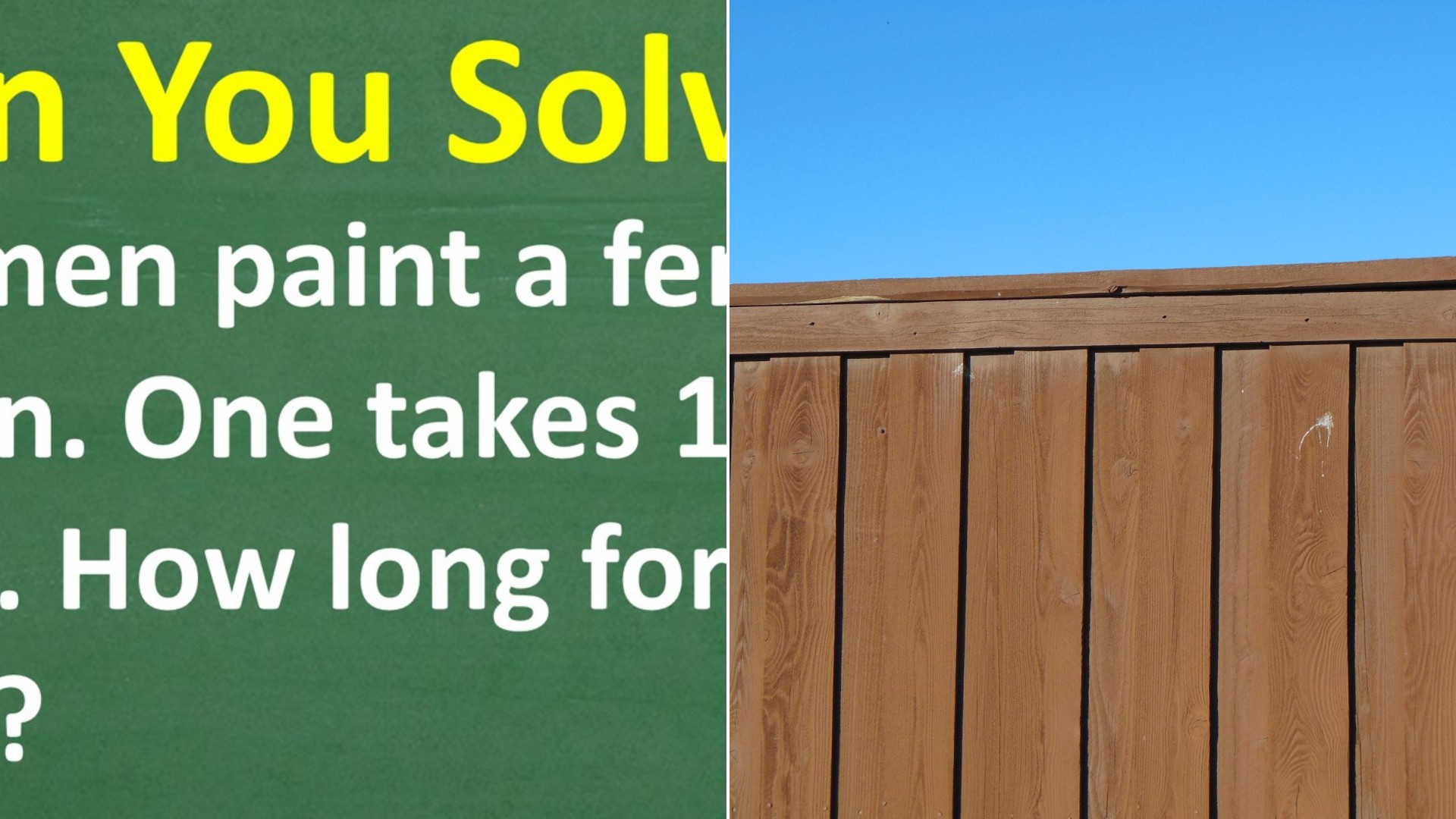
The math teacher at TabletClass Math says most people will have a tough time with it, and the most popular approach leads straight to the wrong answer. Give it a try before reading on, and keep a pencil handy, because the right method matters more than quick arithmetic here.
The Tempting Shortcut That Fails
A lot of people look at the problem this way, the teacher explains. One worker takes 60 minutes. The other worker’s time is the missing piece, so call it x. The two of them together take 40 minutes, so maybe 40 is simply the average of 60 and x.
Set up that way, the math looks easy. You write (60 + x) divided by 2 equals 40, cross multiply to get 60 + x equals 80, and subtract 60 from both sides. That gives x equals 20, so the second man seems to need only 20 minutes.
Why 20 Minutes Cannot Be Right
Check the answer against the story and it falls apart. If one man can paint the whole fence alone in 20 minutes, how can adding a second painter make the job take longer, at 40 minutes? Together they should finish faster than the quicker man working by himself.
The average of 60 and 20 is 40, so the numbers seem to fit on paper, but the answer makes no sense in the real world. The teacher is clear that averaging the two times is not the way to solve this kind of problem, even though plenty of people reach for it.
Think in Terms of Speed
The key, he says, is to stop thinking about how long each person takes and start thinking about their rate, meaning how much of the job each does in one minute. First, get the units to match, so the one hour becomes 60 minutes. For the sake of the puzzle he names the workers: Ed, who needs an hour alone, and Bob, the one whose time we are hunting for.
Ed paints 1/60th of the fence each minute. In 30 minutes he finishes half the job, and in 60 minutes he finishes all of it. Working together, Ed and Bob finish the fence in 40 minutes, so their combined rate is 1/40 of the job per minute, which means half the fence gets done in 20 minutes. Bob’s rate is 1/x, with x being the number of minutes he needs alone.
Building the Equation
Because their speeds add up when they work side by side, Ed’s rate plus Bob’s rate equals the team’s rate. That gives the equation 1/60 + 1/x = 1/40.
The cleanest way to solve it is to clear the fractions. Multiply every term by the lowest common denominator, which here is 120x. This uses the distributive property, and the teacher calls it basic algebra that makes the rest super easy.
Solving Step by Step
Run through the multiplication one term at a time. For the first term, 120x times 1/60 leaves 2x, because 60 goes into 120 twice. For the second, 120x times 1/x leaves 120, because the x values cancel. For the third, 120x times 1/40 leaves 3x, since 40 goes into 120 three times.
Now the equation reads 2x + 120 = 3x. Subtract 2x from both sides and you get 120 = x. The units are minutes, so Bob needs 120 minutes, or 2 hours, to paint the fence by himself.
Checking the Answer
The result passes the common sense test. Ed paints the fence in 1 hour and Bob takes 2 hours, so Ed is the faster painter, and the team finishes quicker than either would alone. In 40 minutes Ed completes two thirds of the fence, since 40/60 reduces to 2/3, and Bob completes one third, since 40/120 reduces to 1/3. Two thirds plus one third makes one whole fence.
If you landed on 2 hours, the teacher says you deserve a happy face, an A+ and a 100%. And if you worked it out on your own another way, he says, great job, because there are other ways to solve this problem too.
A Rule You Can Reuse
The lesson is that rates, not times, are what combine when people work together. Ed’s speed and Bob’s speed simply stack up, and that is why the equation works when the average does not.
This kind of puzzle is called a work rate problem, and the method carries over to other situations. Whenever two people, two pumps or two machines share a task, turn each one’s time into a rate by dividing 1 by its time, add the rates together, and set the sum equal to 1 divided by the combined time. Then solve for whatever is missing.
It is also a good habit to ask whether an answer makes sense before you trust it. The wrong answer here only looked reasonable because the average of 60 and 20 happens to equal 40, but a second painter cannot make a job slower. For anyone who enjoys keeping the brain sharp, working a puzzle like this over coffee is a pleasant way to do it, and it makes a fun challenge to hand to the grandkids at the kitchen table.
More Stories You May Like
- Couple Renovating a Fixer Upper Knew Something Was Off About One Wall, and When They Finally Opened It They Found a Massive Termite Nest Instead of Insulation
- Homeowner Cleaning Out The Basement Notices A Damp Spot, Pulls Off A Section Of Wall, And Finds A Hidden Door Framed In Wood Behind The Block
- HOA Threatens Fifty Dollars a Day in Fines over Weeds Even Though the Homeowner Mows Every Two Weeks
Leave a Reply